I am a bit partial to K-dramas. My first foray into them was Extraordinary Attorney Woo. I then watched The Glory, and ever since, I have been hooked. The list is now far too long to write here.
Yet, strangely, I have never written a review of any of them. I have been guilty of holding my friends and family at ransom instead, regaling them with detailed accounts of my latest watches.
But this particular series made me want to put my thoughts down.
I was hooked when the lead protagonist said: “When teachers are afraid of children, the society is doomed.” He echoed my thoughts exactly.
A teacher by profession and inclination, I am even more passionate about a drama that puts teachers, students, parents and the education system at its centre. It is bound to appeal to me.
The South Korean school system portrayed in the series often feels remarkably familiar. There are endless studies, pressurising parents, overworked teachers, competitive examinations and cut-off marks. What I hope is different is the extent of bullying portrayed in Korean dramas. I sincerely hope schools here aren’t as terrifying. And then I realise I may be living in a utopian dream.
The first episode begins with the powerful dominating a school and bullying the “outcasts”—children who don’t have powerful fathers, aren’t rich enough, or simply don’t fit in. Most of the students aren’t actively involved, but silence can be damning. You keep your head down and hope you aren’t the next one to be picked.
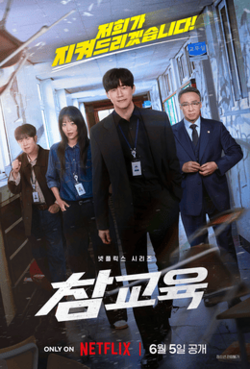
Into this chaos steps Inspector Na Hwa-jin, of the newly formed Education Rights Protection Bureau (ERPB) under the Ministry of Education. The school is being held hostage by the spoiled son of a powerful politician. The teachers and principal are helpless. An ex-soldier, he comes armed with his own very unconventional methods of restoring order. With two colleagues—Im Han-rim and Bong Geun-dae—and the backing of his boss, Choi Gang-seok, he takes on not just individual troublemakers but the system that allows them to flourish.
Hwa-jin has his own painful history. His young, passionate teacher-wife was brutally stabbed by a student whom she tries to help. We learn the backstory gradually through the ten episodes. His father-in-law, Choi Gang-seok, is also the president of the ERPB. Im Han-rim is another formidable fighter, while Bong Geun-dae, the technological geek, provides much-needed humour in an otherwise serious narrative.
In the second episode, Hwa-jin uses his special-ops skills to take on a school gang and protect a student whose only crime is wanting to study. This is one of the recurring themes of the whole series. Allow the interested students to learn.
One episode particularly resonated with me. A teenage influencer makes false allegations against her mathematics teacher. When her male homeroom teacher confronts her, she uploads a video accusing him of sexual assault. The allegation spreads faster than the truth ever could, and he is subjected to online trolls.
Emboldened by her growing number of followers, the student holds the school to ransom until Inspector Im Han-rim steps in.
I found this episode particularly disturbing because the world of influencers worries me. We are seeing our own version of this phenomenon grow rapidly. Give someone a smartphone, an audience and a willingness to make accusations, and havoc can be created in minutes.
A video goes viral. People emerge from every corner to take sides, reputations are destroyed—and no one bothers about the veracity of the allegation. Sad indeed.
Another episode takes the team to an elite school to investigate why a student attacked a respected teacher. Here, the series turns the tables and reminds us that teachers too can be monsters.
And then there is this parent who constantly calls her son’s teacher and dictates how she should do her job to the extent that the teacher loses all her spirit. She becomes a shadow of what she was. Hwa-jin substitutes for the teacher and turns the table and how! This episode is the most humorous of the lot. Parents can be as much of a bully as children—and sometimes more so. Once they believe that paying school fees gives them ownership over teachers and the right to dictate how a school is run, things can go terribly wrong, and it doesn’t help their own child any.
The subsequent episodes tackle drug use in schools, including the frightening use of underage children as conduits. The exploitation of juvenile law is also examined. When the parents of offending boys arrive to protect their children, the ERPB president delivers another of my favourite lines: “Teach your child kindness, not power.” That, surely, should be pinned on every school gate.
Another episode deals with the crushing pressure placed on children to clear fiercely competitive entrance examinations and the lengths to which parents will go to ensure their child’s success-all in the name of sacrifice. But, as Hwa-jin points out, it isn’t your sacrifice. Your child is sacrificing his life for your dreams. How often do parents live vicariously through their children?
This episode reminded me of Sky Castle, another Korean drama, in which an entire community seems to measure its worth through the achievements of its children. One child’s success becomes another parent’s failure, and education ceases to be about learning and becomes a never-ending competition.
Despite the seriousness of the subjects, the series, Teach You a Lesson, has plenty of lighter moments, particularly in the way Hwa-jin and his team investigate cases. The humour prevents the drama from becoming unbearably grim.
There was another line that stayed with me: “When the perpetrators stand taller than the victims, it is not correct.”
Unfortunately, that sentiment extends well beyond the school gates. We have all seen people accused of serious crimes posing for cameras, flashing victory signs as they are taken away by the police—or, worse, making obscene gestures as though they have achieved something heroic. When the perpetrator can stand taller than the victim, something is fundamentally wrong with the system.
I have written quite a few articles on teaching and parenting for Open Page and Deccan Herald, some serious and some satirical. Perhaps that is why this series struck such a chord with me.
Authority and discipline, tempered with humanity and a little fun, are essential to learning. That is the absolute truth, nothing else.
With an excellent IMDb rating, this series is a must-watch for teachers, parents, and students alike.
This blog post is part of ‘Blogaberry Dazzle’
hosted by Cindy D’Silva and Noor Anand Chawla
in collaboration with Tanvi Agarwal.
Image credit: The Net
I haven’t watched any of the K-dramas here. The one I had started watching but did not continue, long back, was probably The Three Sisters.
I’ve yet to watch K dramas seriously, but this one seems to focus on many growing concerns. The internet has become an untamable monster. What a scary world we have turned inventions and conveniences into.
“Teach your child kindness, not power” deserves to be on every school gate, exactly as you said. The influencer episode is what stayed with me most too, an accusation spreading faster than truth ever could feels less like fiction and more like a warning about where we already are. Loved that the series also flips the lens onto teachers and parents as bullies, that balance is what makes it feel honest rather than one sided.
I am guilty as charged. I have not watched K dramas. I am a Pakistani drama fan. The school somehow sounds like an Indian school in UP or Bihar. In India, parents too are turning into bullies. I do not remember my parents entering my school,ever. Influencers are there in schools too these days.
I dunno why I cannot relate to K-drama, I know it has some kind of hype but still haven’t watched any of them. What a thoughtful review and coming from a teacher, it carries real weight! “Teach your child kindness, not power” genuinely belongs on every school gate. The school today have become super scary for even teachers or shy students as everyone turns into a bully with those smartphones. I even see this trend of teacher tiffin shaming kids through reels and making their living by talking bad about the mothers which is wrong on so many levels.
Your review is quite detailed, loved it. I am not a K-drama fan but seeing it through your review feels how much you love them.
I’ve not yet made a foray into K-dramas expecting them to mostly cater to shallow rom-com loving Gen Z. This one though sounds a story that’s independent of borders and something a teen parent like me would relate to. Good review! You surely enjoy your K-dose. 🙂
I have not yet watched even a single K drama. I heard people appreciating it but never developed the urge to watch any, as some how even the poster of K dramas failed to make me watch them. But you have gave a wonderful review of this drama…. sounds interesting lets see when I can watch
I have not initiated myself into the K-pop world. The reasons are unknown to me; perhaps a mental block. But I read every word of your review, and some lines stayed with me. I am not sure if the problem is with the education system or with the people who keep quiet. Surprised to know that the system in Korea is largely similar.
Sounds like an interesting story. I have not watched any K dramas though. Had read about Attorney Woo and was thinking of watching it but never really got around to it.
I really enjoyed this review because it goes beyond simply recommending a K-drama and connects its themes to real issues in education, parenting and society. The writer’s personal perspective as a teacher makes the discussion of bullying, parental pressure and the misuse of social media feel especially genuine and thought-provoking. It definitely made me curious to watch Teach You a Lesson, especially to see how the drama balances such serious subjects with humour and humanity.
I’ve been postponing watching these series , after your review I will watch it sooner
Your review captures the emotional layers of this Korean drama beautifully. The themes of healing, relationships, and personal growth sound compelling. Loved how thoughtfully you explored its deeper messages.