
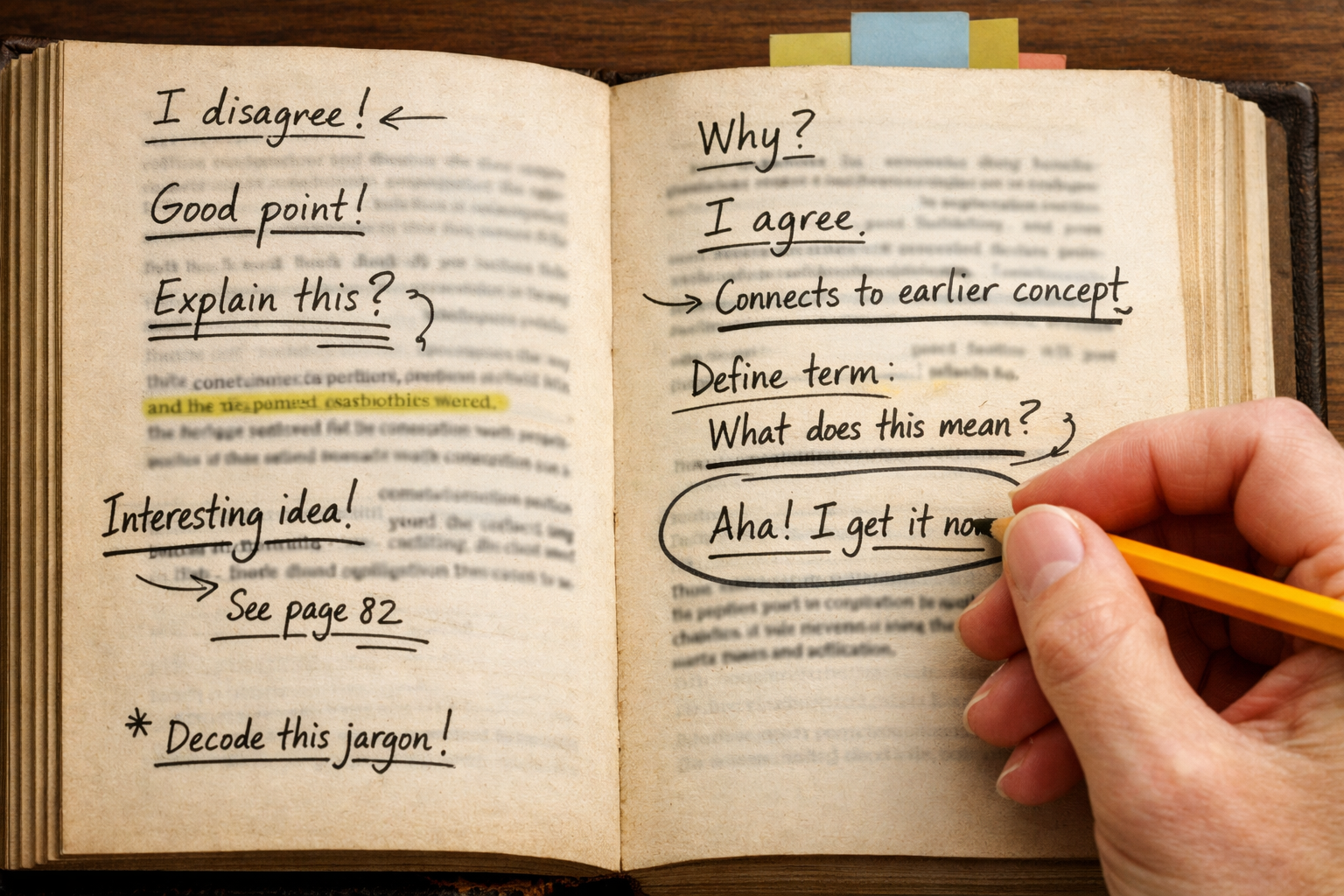
Francis Bacon once remarked, “Some books are to be tasted, others to be swallowed, and some few to be chewed and digested.”
What better way to chew and digest a book than marginalia? Throughout my school life, I had made do with second-hand textbooks. And if the margin of the book had an “imp” next to it, or a paragraph enveloped in parentheses, it meant one more reading of the same. It didn’t matter if the other person had scored better. It just meant that someone found it important enough to make an annotation, and it must be important. I added my own inputs before I gave them over to someone else. But then my additions were mostly doodles. That often reflected how bored I was in most of my classes!
What is marginalia (mär-jə-ˈnā-lē-ə)?
The dictionary meaning of Marginalia means:
- marginal notes or embellishments (as in a book)
- nonessential items. Example: the meat and marginalia of American politics.
Medieval manuscripts often had curious images and drawings of rabbits, cats, and snails combined with an elaborate and illustrative style of writing.
Marginalia reminds us that reading is rarely passive. Reading and writing go hand-in-hand. In the margins, we argue, agree, question, and discover that we can connect ideas and decode jargon.
The term “Etymology” is the study of the origin of words. The practice of etymology is uncovering the truth by tracing the root of a word and its evolution thereafter.
So, where does marginalia come from?
In the introduction to his essay titled “Marginalia,” Edgar Allan Poe wrote: “In getting my books, I have always been solicitous of an ample margin; this not so much through any love of the thing in itself, however agreeable, as for the facility it affords me of penciling suggested thoughts, agreements and differences of opinion, or brief critical comments in general.” The essay was published in 1844, and the term marginalia was only a few decades old, despite notes in the margins of texts having existed for centuries. There is supposed to be another word apostille (or apostil). It refers to a single annotation made in a margin, but that word is rarely used today.
So, even if you are not a Poe and not too keen to scribble in your own books, marginalia are a sure-shot sign that someone has read that before you. While researching, I found that there are many notable books based on marginalia. I haven’t read any of them, but now I am truly tempted to after coming across them. I am giving a few examples below.
- by J.J. Abrams and Doug Dorst (2013): This is perhaps the most famous contemporary example. The book consists of a novel (Ship of Theseus by a fictional author, V.M. Straka) with extensive, handwritten notes, postcards, and maps left in the margins by two readers, Jennifer and Eric, who are trying to solve a mystery surrounding the author.
2. Pale Fire by Vladimir Nabokov (1962): Comprised of a 999-line poem by John Shade, a foreword, and a long commentary by a shady academic, Charles Kinbote, the entire story is told through the critical notes that gradually reveal a completely different, unreliable narrative in the margins.
(I couldn’t find the link for this book online)
3. House of Leaves by Mark Z. Danielewski (2000): Known for its unconventional layout, this horror novel features a narrative that is constantly interrupted by footnotes, which in turn have their own footnotes, forcing the reader to navigate a claustrophobic, annotated, and layered text.
4. Confessions of the Fox by Jordy Rosenberg (2018): A novel within a novel that utilizes extensive footnotes from a “transgender historian” to annotate and argue with the 18th-century autobiography of a thief.
The excerpt from How to Read a Book, written in the 40s, captures the necessity of marginalia in reading.
When you buy a book, you establish a property right in it, just as you do in clothes or furniture when you buy and pay for them. But the act of purchase is actually only the prelude to possession in the case of a book. Full ownership of a book only comes when you have made it a part of yourself, and the best way to make yourself a part of it— which comes to the same thing— is by writing in it.
But then, it is difficult to give away our books, and the marginalia remains a librarian’s nightmare.
But then, are you the kind who loves to annotate, doodle, and believe in marginalia even if you didn’t know the term for it before? Would love to hear from you.
hosted by Cindy D’Silva and Noor Anand Chawla.
sources:
https://www.merriam-webster.com/dictionary/marginalia
Image: Created with the help of AI.
I am one of those people who don’t mark my books or fold page corners. Reading this was painful!:)
Haha. I too don’t mark but used to doodle ! Truth be told, never heard about it .
Personally, I keep my books totally clean. But it was interesting to know the origins of marginalia. I would like to check the books you have mentioned though. I do enjoy little illustrations on the side though.
It’s amazing how a small word like marginalia can open up such an interesting way of thinking about books and reading. Enjoyed reading this!
Words and their detailed meaning can go so deep! I am so drawn to read House of Leaves now.
I totally love marginalia. All my lessons in life came from the marginalia I created while reading books, both fiction, nonfiction, and textbooks too. Marginalia adds life to a book, making the good ones great, and the not-so-good ones to tolerable ones because I think the essence of our learning comes out in the notes we make!
Yayyy! I knew this word. You had me glued to the post with the first quote itself, Chandrika. Francis Bacon once remarked, “Some books are to be tasted, others to be swallowed, and some few to be chewed and digested.” This is so familiar. When I used to write, I added quotes, but these days, readability goes down with them. Like you, most of my books were second-hand. I used to write in the margins too, but not anymore.
Reading and writing go hand in hand true that. Finding the best words to write comes from reading extensively. Nice post.
Really like the new look of the blog, Chandrika. Took me a few seconds to figure out whose blog I’m on 🙂
As for this post, your exploration of marginalia was fascinating. I loved how you connected the simple act of scribbling in the margins to the deeper idea that reading is an active conversation with a text.
As usually this was an interesting post that helped me learn a new word and how it came into existence
I loved this! Your deep dive into word origins makes me see everyday language in a whole new light. It was fun, fascinating, and totally relatable.
love this! i LOVE marginalia but just didnt know the term for it till now. i totally need a good margin and a sign of a good book, and a well-loved one is one with annotations & even doodles 🙂
PS: the recommendations are fascinating.
I loved this, Chandrika. I highlight texts but never write much. Recently, I did write on the margins because it helps when you come back to review it. And that is when I was thinking that with my written stuff, I cannot give the book away to someone after reading it. In school, yes, I have used the margins to the fullest. I think in those days many of us had that habit. Teachers also used to ask us to write points in the margins. Your post brought back so many memories!
Marginalia … No idea about this word. But the meaning what I can capture from your post is not something I will prefer to do. I have seen fellow bloggers writing on the books or marking it with highlighter… the fact is that I cant say them anything but if they did it on my books I swear i dont know what I will do with him or her. What so ever Marginalia is …. its not for me.
I never thought much about marginalia, but it’s fascinating how little notes or doodles can bring a book to life and capture your own learning. Makes me want to try it in my next read.
Your post immediately reminded me of the Half Blood Prince! I used to highlight or write sometimes in books but now I read a lot on the phone so that option is gone!
My books remain absolutely pristine after reading. I have never dogeared them, and writing on the pages is something I will never fathom!
I keep my books in pristine condition but I do enjoy reading marginalia in other books!