
Long, long ago, many years ago, all around us, families were running away, carrying whatever they could. The rumour floated around that “Nagarjuna Sagar dam has broken, and we are going to be swept away.”
My mother stood on the balcony with her brood of three, and I was the youngest at around seven, waiting for my father to return home. She had kept a small suitcase ready with whatever little treasures we had, and was panicking when she saw the neighbours all running away.
My father sauntered in. I didn’t understand much, but what I heard from him was, “We can’t outrun water, and if the rumours are true, we die anyway. It is either here in the comfort of our house or elsewhere.”
Terrified at the word “die”, we sat around our father while he chanted Slokas and kept us engaged with mythological stories. The next morning, people returned sheepishly while we slept deeply in our own beds.
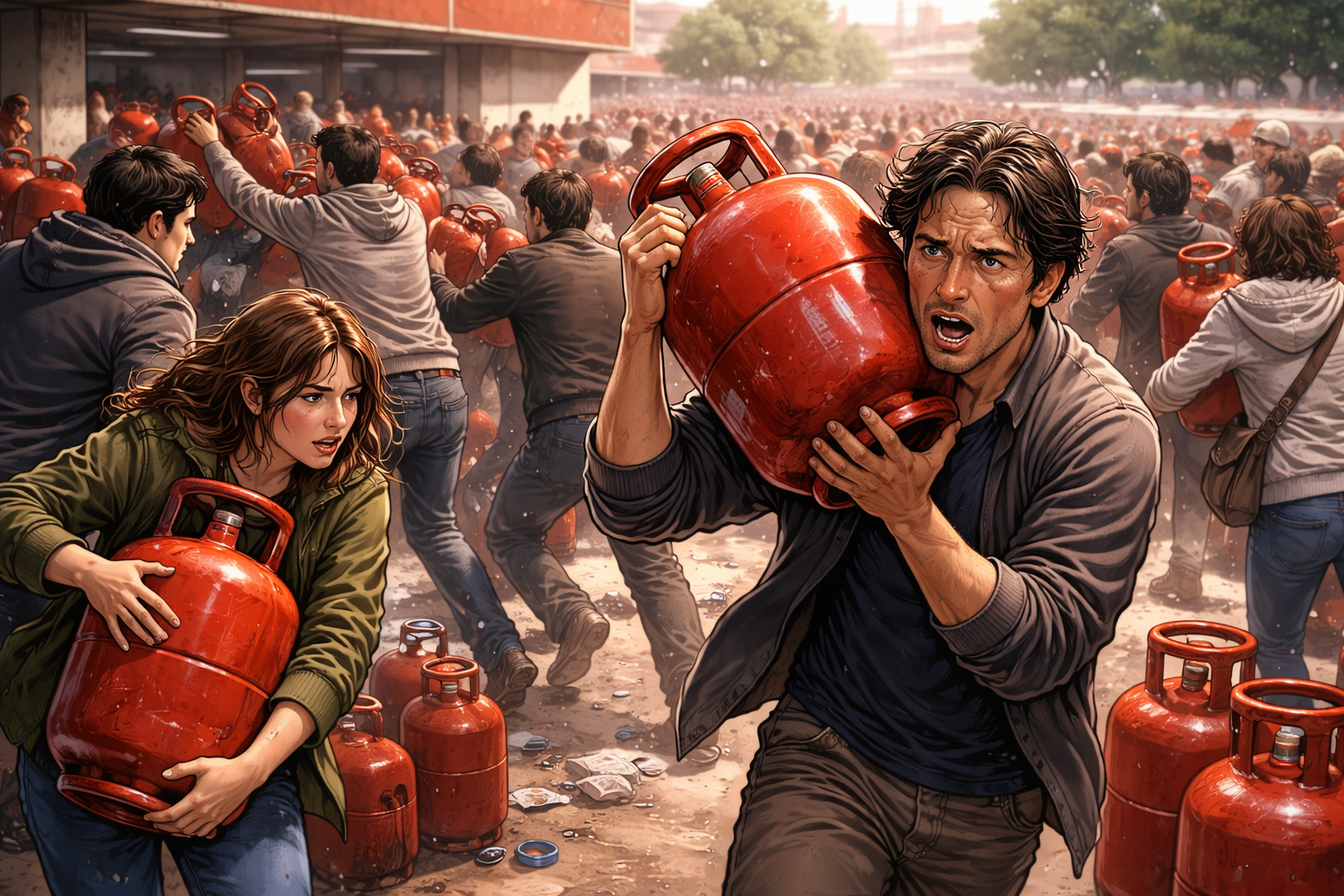
Why am I remembering this today? A WhatsApp message landed about how the shortage of LPG cylinders is going to cause havoc due to the ongoing war. The message read in a telegraphic manner, Watch news, collect cylinders! The scary visuals of people lining up at both the gas company and petrol bunks were all over the news channels. The government is trying to crack down on the black market.
Any war is unnecessary, and this too is. We don’t know how long it will last, or how much we and the world around us will be affected by the unnecessary tensions it causes. But then, can we outlive all around us if we manage to collect all the cylinders in the world? That remains the pertinent question. I remember reading about ‘a bank run’ for the first time in Arthur Hailey’s Money Changers. It taught me that banks can potentially collapse if all the depositors come to withdraw all their money on one particular day.
Rumour is generally unverified, organic information passed informally, like how the present scenario is playing out. It creates panic. The war is on, and the energy supplies are dwindling. Unfortunate that the powers to be are involved in whataboutery, and Propaganda. The panic is, in turn, making people hoard LPG cylinders. One man has gone a step further and hoarded 1000 litres of petrol in Punjab.
So, where does the word ” panic ” come from?
The term “Etymology” is the study of the origin of words. The practice of etymology is uncovering the truth by tracing the root of a word and its evolution thereafter.
Panic comes from the name of the ancient Greek god Pan, who possessed a stentorian voice. It is said that the ancient Greek gods were battling a horde of giants, and Pan’s shout was so overwhelming that it instilled fear in the gods’ opponents, aiding in their eventual victory. He occasionally caused humans to flee in fear, which is where the commonly used sense of panic comes from.
This word existed in English as an adjective or adjectival form modifying such words as fear, fright, or terror. For ex: Panique feare
By the early 17th century, panic had already jumped from one part of speech to another and began to be used as a noun. It took some time for Panic to be used as a verb, and that happened only at the end of the 18th century.
In the early 20th century, panic took on yet another distinct meaning: “something very funny.” For example: The comedy show was an absolute panic! It is used more as slang. Though the meaning is completely at odds with the earlier sense, it actually makes perfect sense considering the word descended from a god whose nature provoked both merriment and fear.
The very panic is turning all of us into a hoarder- a morbidly overzealous collector! And if you have more than 3 cylinders, you might be breaking the law.
But, I do wish the war ends, and better sense prevails among the powers-to-be.
https://www.merriam-webster.com/wordplay/the-mythological-origin-of-panic
https://www.etymonline.com/word/hoard
This blog post is part of ‘Blogaberry Dazzle’
hosted by Cindy D’Silva and Noor Anand Chawla.
Image credit: AI ( I have fallen in love with ChatGpt!)
An interesting post with a word that needed mych attention for the current situation
What a wise man your father was. Such stability and strength. Honestly, I enjoyed your real life incident more than the word, panic. 😛
I watched people hoarding in Covid-19 also. I think the world has no commonsense.
Super interesting to know about the roots behind the word panic! Had no idea that there was a Greek god called PAN.
Your posts are so interesting and engaging, Chandrika. Loved how your Father handled the situation. Such a wise man. Also, it was such a surprise to know where the word Pnic was derived from.
What a way of clubbing a live occurrence and the word panic. I have only one spare cylinder, which is full. People create panic and start hoarding, and middlemen have a field day lining their pockets. I did not know that the word panic is used as slang. Learnt something new once again, thank you.
The way you start the etymology every day, with a personal touch, makes these reads more interesting.
That’s a good one, Chandrika. Your word for the post is something we all need to sit and think about. I wonder how your father would react to this situation, given that even when the dam was broken, he was able to keep his cool…such a practical man! I wish I could be like him. I panic for no reason, but surprisingly, I’m not panicking for LPG shortage; it’s a rumor, no doubt. 🙂
Such a small word but with such a loud meaning and even louder implications, especially in the current situation. Personally, I feel this word sounds like a fake alarm and causes unnecessary chaos. What do you think?
Super article! Panic and Pan! Now it makes sense. Your image is awesome! The panic is evident!
Your exploration of word origins was once again so insightful. I love how you make etymology feel like uncovering little stories hidden in language. Such a fascinating read
Panic- the origin is quiet interesting for this word and again a great analysis. Just like your father I fall on the same plate. I know I cannot run after things to make my home, and my family war effect free as that’s not feasible. If something is going to impact India, then whole of India will have to face it and I cannot be an odd man out. Rather stay calm, think positive and enjoy the moments.
The current situation is really mind boggling. I pray every day for things to get back to normal around the whole world.
Loved how you blended a real-life moment with the meaning of the word Panic. My father always had that same calm, grounded way of handling situations too, and it really stands out here. It’s such a reminder of how quickly people react without thinking, even when there’s no real reason to panic.
I too wish the war ends soon. What foolishness for it to have gone on for so long!