
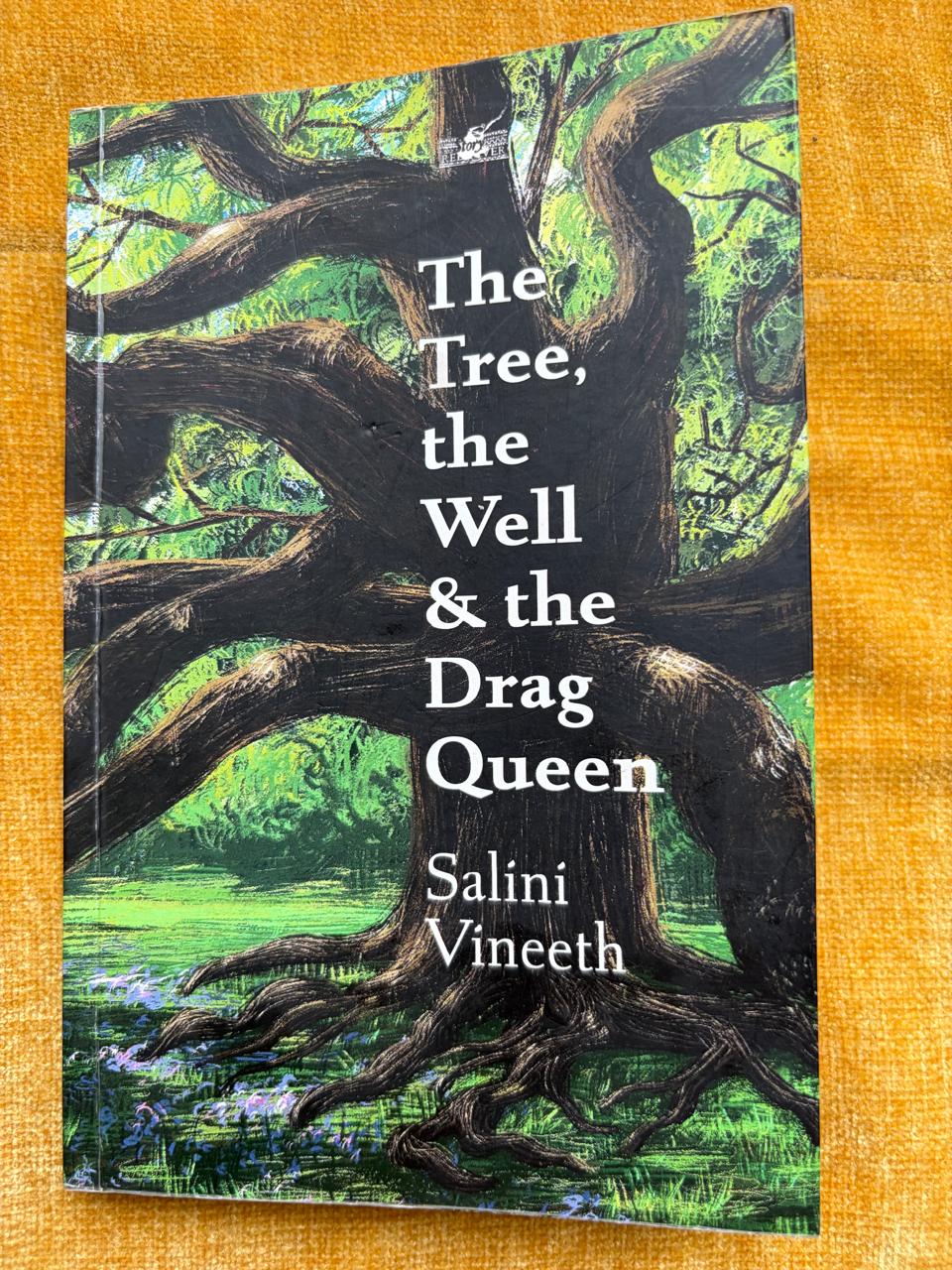
I am late to this review party. I read the book quite a while ago, but I struggled to gather my thoughts about it. None of my earlier attempts seemed to encapsulate all that I felt about the book. To put my response into perspective, I still remember passages from it months after reading it. I think I wrote more drafts for this review than I have for some of my own stories!
I am never much into fantasy nor taken in by horror. So, when I picked this thin volume, it was more for the author than the plotline itself. Right from her first book, I have been a fan of Salini’s work. She is an authentic author. Her words and sentences are carefully crafted and told with honesty.
For the very few who haven’t yet read this, Vineeth very cleverly makes the very tropical jackfruit tree, whose fruit is deemed the state fruit of Kerala, transmogrify into a demonic tree. And how!
Right from the prologue, she sets the pace. A gentle, evocative dance that does not rush but does not dawdle either. Centuries ago, a man and a woman in search of an elusive treasure dig themselves into a life of servitude. All they leave behind for the generations to come is a deep well and a demonic jackfruit tree whose roots go down the well. Once again, the author reaches into the very Keralite belief in the Chatan- that keeps the generations to come firmly entrenched in the fist of the evil force of the tree. Our young protagonist is thrown into this unlikely duo mix. He is fighting his own demons when he realizes that he does not want to be like his moustache-growing father, but more genteel.
Chapter one begins with his own battle of being trapped in the gluey sap of an enormous jackfruit with no escape in sight- thus metaphorically describing his own life. He remembers how he had to pack his seventeen years of his life in a plastic bag under the watchful eyes of his paternal grandmother-his Ammachi, who was his only support way back then and helped him escape the demonic tree and the dry land of the village. That was ten years ago. From Kerala to Mumbai and back again, we live their (his) life through their(his) childhood and youth.
We have all read the quote by Francis Bacon that says, “Some books are to be tasted, others to be swallowed, etc., etc!”
What if the reader has to turn back to reread parts because the words demand that pause of the reader? Then the whole process becomes slower; words turn meatier and chewier, and leave the whole process memorable. Reading is rarely passive. I am not a marginalia person, but this once I wanted to underline words and mark the evocative prose with a pencil so I could return to it.
My favourite part of the book, among many, was the very honest paragraph where the drag queen ponders: the more I got to know people around me, the more I realized that everyone was pretending, one way or the other. Maybe that is the only way to survive, by killing a part of yourself and pretending to be someone else.
I also loved the way the character explains the difference between adopting a persona and being a gender-nonconforming person through the analogy of a painter. That was indeed a clever scene. They say to a friend, “Okay, you are a painter, right? So what if someone tells you that you can paint in only three colours? White, blue, and black, or a mix of these colours. You’ll immediately say it is ridiculous. The case of gender is like that: if we can accept infinite colours of the sky, why can’t we accept infinite possibilities of genders?
I cannot expect more of an empath than the drag queen.
Towards the end, when the protagonist realizes that it was the quicksand under the demonic tree that was trapping people. They have to cut off the taproot to break free.
I conclude with a deep bow and immense respect for the author’s ability to weave the contemporary exploration of gender identity seamlessly into a narrative steeped in folklore and myth. The drag queen’s personal quest to lead a more authentic, less fearful life is a stroke of ingenious storytelling.
This blog post is part of ‘Blogaberry Dazzle’
hosted by Cindy D’Silva and Noor Anand Chawla
in collaboration with Tanvi Agarwal.
That definitely has an intriguing angle of a demonic jackfruit rooted in quicksand. I didn’t know of this author, so got to pick it up now.
Intriguing title and story, Chandrika. Your review eggs me on to get my hands on this book by Salini! Never heard of a Salini before. These days pronouns have escalated and we have to get our grammar right. I too believe in Live and let Live and each to his own. Why do we have to add labels to a person? The thought of a demonic jackfruit is interesting. Thanks for this review of The Tree, the Well & the Drag Queen. Looking forward to reading it.
This sounds like an interesting read to me. I am looking forward to read Shalini’s work some day.
This book has been a great read for me. Salini’s Instagram channel had been a rich source of information on gender and LGBTQA studies.
What a beautifully considered review. The fact that it took you more drafts than your own stories tells me everything about how deeply this book landed.
Sounds like a very interesting and intriguing read. And I like that it is rooted in local culture. I like the horror genre though have watched more movies than read books in this genre.
Thank you for introducing this book to me through your review. It sounds like an insightful read, especially for the way it brings these conversations into a wider literary space. Adding it to my reading list and looking forward to exploring it myself.
Demonic jackfruit tree rooted in quicksand, what an unsettling, brilliant image tied so deeply to Kerala’s identity. That painter analogy for gender is one of the simplest, sharpest explanations I’ve read. Needing more drafts for this than your own stories says it all, adding this to my list now.
What stayed with me most was how beautifully the book blends Kerala’s folklore and mythology with a deeply human exploration of identity, fear, and the desire to live authentically. I loved how the demonic tree becomes more than just a supernatural element—it feels like a metaphor for the invisible forces that trap us and keep us from being our true selves. The drag queen’s reflections on gender, identity, and pretending felt especially powerful and thought-provoking. For me, this is the kind of book that stays with you long after you’ve turned the last page.